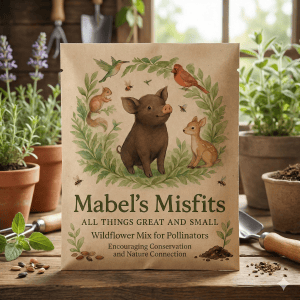
There is a reason Mabel’s Misfits is so close to my heart.
It isn’t just about animals.
It isn’t just about plants, conservation, or creating wildlife habitat.
It is about people.
It is about giving people a reason to get outside, to learn something new, to feel useful, to connect with something living, and to discover that they can make a difference.
And that isn’t something only children need.
Mabel’s Misfits is for everyone.
Children. Teenagers. Adults. Seniors. Families. People who have never planted a seed before. People who know everything about gardening. People with disabilities. People who learn differently. People who feel like they don’t quite fit anywhere else.
There should be a place in conservation for all of us.
It Starts With Curiosity
Think about what happens when someone finds a caterpillar.
At first, it’s just a little bug.
Then they learn that it will become a butterfly.
Then they learn that some butterflies can only lay their eggs on certain plants.
Then they learn that those plants are disappearing.
Suddenly, that little caterpillar matters.
And once someone understands that the caterpillar needs them, even in a tiny way, something changes.
They start looking.
They start noticing.
They start asking questions.
And eventually, they start caring.
That’s where conservation begins.
Not with a statistic.
Not with a scary headline.
It begins when someone falls in love with something worth protecting.
I Want People to Get Their Hands Dirty
One of the things I love most about Mabel’s Misfits is the idea of getting people outside and doing things.
I want people building.
I want people planting.
I want people growing.
I want people clearing invasive plants.
I want people getting dirty.
I want people taking pictures of the animals they find and recording what lives around them.
I want someone to build a birdhouse and understand why the entrance needs to be a certain size.
I want someone to plant a seed and discover that growing something takes patience.
I want someone to learn that sometimes the plant dies—and that’s okay.
You try again.
I want people to experience the satisfaction of looking around one day and realizing that something they helped create has become a home for another living thing.
A butterfly is feeding there.
A bee is collecting pollen.
A bird is eating the berries.
A frog has moved into the garden.
And suddenly you realize:
“I made this place better for something else.”
That feeling is incredibly powerful.

Conservation Is for Every Age and Every Ability
One of the things I want Mabel’s Misfits to demonstrate is that you don’t have to be a certain age, physically able in a certain way, or have a particular background to contribute to conservation.
Not everyone can dig a garden.
That’s okay.
Someone can photograph wildlife.
Someone else can identify plants.
Someone can record observations.
Someone can paint or draw what they see.
Someone can help design a birdhouse.
Someone can plant seeds in containers.
Someone can sit quietly and watch a bird feeder.
Someone can help organize an event.
Someone can teach someone else what they’ve learned.
There are countless ways to participate.
Conservation doesn’t have one doorway.
There should be a doorway for everyone.
And sometimes the person who can’t physically do the work is the person with the knowledge, creativity, encouragement, or experience that makes the work possible.
That matters too.

These Are Life Skills, Too
Something else that matters to me is that conservation teaches so much more than conservation.
Building teaches problem-solving.
Gardening teaches patience.
Growing plants teaches responsibility.
Working with tools teaches safety and confidence.
Recording wildlife teaches observation and attention to detail.
Working with other people teaches teamwork.
Caring for animals teaches empathy.
And sometimes, failing teaches the most important lesson of all:
You can try again.
Those are skills people can carry with them for the rest of their lives.
They don’t stop being useful when the activity is over.
Nature and Mental Health
There is another reason this work matters so much to me.
We talk a lot about the conservation crisis facing wildlife.
But alongside that crisis is another one that we cannot ignore:
the ongoing mental health crisis.
People are lonely.
People are overwhelmed.
People are stressed.
People are struggling with anxiety, depression, grief, trauma, isolation and simply trying to keep up with a world that can feel like it never slows down.
Mabel’s Misfits cannot—and should never try to—replace professional mental-health care.
But I believe nature can be part of the support system.
There is something about stepping outside and putting your hands in the soil that makes the world feel a little quieter.
There is something about caring for an animal that reminds us that we are needed.
There is something about watching a seed become a plant that reminds us that change takes time.
There is something about sitting beside a creek, listening to birds, watching butterflies or searching for mushrooms that pulls us out of our own heads for a moment.
And sometimes, a moment is where healing begins.
You don’t have to accomplish something enormous.
Maybe you planted three flowers.
Maybe you photographed a bird.
Maybe you sat outside for twenty minutes.
Maybe you helped someone build a wildlife shelter.
Maybe you simply came to an event because you didn’t want to spend another day alone.
That counts.
Animals Teach Us Compassion
Mabel’s Misfits also comes from a deep belief that animals deserve to be treated with respect.
That includes the animals people think are cute.
But it also includes the animals people don’t understand.
The opossum.
The snake.
The spider.
The bat.
The moth.
The little creature someone might normally want to get rid of.
People need to learn that wildlife isn’t here for our entertainment.
It doesn’t exist for us to capture, hold, or keep.
Sometimes loving an animal means helping it.
Sometimes it means leaving it alone.
Sometimes it means calling a wildlife rehabilitator.
And sometimes it means simply giving an animal somewhere safe to live.
Real compassion is putting the animal’s needs before our own.
That is a lesson that applies to every age.

Why This Is Personal to Me
And this is probably the most important part.
Mabel’s Misfits didn’t come from a business plan.
It came from my heart.
Animals have been there for me through some of the hardest parts of my life.
They have given me something to care about when life felt overwhelming.
They have given me a reason to get up and keep going.
There is something incredibly healing about caring for another living thing.
A plant doesn’t care if you’ve had a terrible day.
You still have to water it.
An animal doesn’t care about your mistakes.
It still needs you.
Nature doesn’t judge you.
You can walk outside having the worst day of your life and come home having watched a hummingbird, found a mushroom, heard an owl, or discovered a new wildflower.
For a few minutes, the world feels a little less heavy.
I’ve experienced that.
And I want other people to experience it too.
Especially people who may be struggling.
People who feel different.
People who feel isolated.
People who have lost someone.
People who are dealing with illness or disability.
People who have retired and suddenly aren’t sure what their purpose looks like anymore.
People who are simply exhausted.
Sometimes we don’t need someone to fix us.
Sometimes we need somewhere to belong.
That’s Why They’re Called Misfits
I love the word Misfits because sometimes the things we overlook are the things that need us most.
The opossum that everyone thinks is ugly.
The injured bird.
The abandoned animal.
The weed growing through the pavement.
The insect nobody notices.
The person who doesn’t quite fit in.
Maybe they aren’t really misfits at all.
Maybe they just haven’t found their place yet.
Mabel’s Misfits is about creating that place.
A place where being different isn’t a bad thing.
A place where curiosity is encouraged.
A place where getting dirty is okay.
A place where mistakes are part of learning.
A place where animals are respected.
A place where people can discover that they have something valuable to contribute.
I think about conservation like a ripple in a pond.

The Ripple Effect
One person plants a native flower.
That flower feeds a bee.
The bee pollinates another plant.
A butterfly lays eggs.
A bird eats insects from the garden.
Someone sees the bird.
They become curious.
They learn about habitat.
They plant something at home.
Their friend sees it.
Their teacher hears about it.
Another garden gets planted.
And suddenly, something that started with one seed has spread much farther than anyone expected.
But the ripple isn’t only ecological.
It can be personal, too.
Someone comes to a Mabel’s Misfits event because they’re lonely.
They meet someone.
They make a friend.
That friend invites them back.
They learn how to grow something.
They discover they’re good at it.
They start volunteering.
They feel useful again.
Someone else sees them thriving and decides to join.
That’s a different kind of conservation.
We’re not only restoring habitat.
We’re helping restore people’s connection to the world around them—and to each other.
We Don’t Have to Save Everything Tomorrow
I don’t expect Mabel’s Misfits to solve the world’s conservation problems overnight.
That’s not realistic.
But I do believe we can help create the people who will make a difference.
We can raise kids who know how to plant.
We can give teenagers somewhere positive to spend their time.
We can give adults an opportunity to learn something new.
We can give older adults a place to share the knowledge they’ve gained over a lifetime.
We can create opportunities for people with different abilities to contribute in ways that work for them.
We can give someone who is struggling a reason to step outside.
We can help people discover that conservation isn’t something that belongs to scientists or experts.
It belongs to all of us.
Because every person has something they can give.
Maybe it’s their hands.
Maybe it’s their knowledge.
Maybe it’s their creativity.
Maybe it’s their time.
Maybe it’s simply their willingness to care.
The Circle Continues
A child learns to love a butterfly.
An adult discovers the peace of gardening.
A senior teaches someone how to grow tomatoes.
A person with a disability records wildlife from their porch.
A teenager builds a nesting box.
A family plants native flowers.
A volunteer helps rehabilitate an animal.
Someone photographs a frog and records where they found it.
A community creates habitat.
And someone else sees all of it and thinks:
“I want to be part of that.”
That’s the circle.
And that’s what I want Mabel’s Misfits to create.
A community where wildlife conservation, education, mental well-being, compassion and connection all meet in the same place.
One seed.
One animal.
One person.
One small act of kindness at a time.
Because conservation isn’t only about saving wildlife.
It’s about creating a world where people still care enough to save it.
And maybe the greatest thing we can do is give people a reason to care.